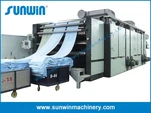
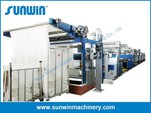
Definition of Polyester Shaping Process
Polyester is a kind of thermoplastic fiber. In a series of dyeing and other processes, the original gate width and coil geometry of the fabric have been changed due to repeated mechanical action and stretching, resulting in deformation and shrinkage, and even skew of the horizontal and straight threads, seriously affecting the quality of the product.
The main purpose of heat setting is to heat polyester knitted fabrics under tension and bake them at specified temperatures, which intensifies the thermal movement of the secondary bonds and molecular chains between the fibers, thus rearranging and arranging the molecules and making the internal stress relatively stable.
Therefore, it can improve the dimensional stability and wrinkle resistance of fabrics, as well as the surface finish, strength and pilling resistance of fabrics.
Two Key Points
The key to heat setting of polyester knitted fabrics is to control the setting temperature and time.
If the heat setting temperature is too low and the time is too short, the fabric surface will be uneven, not stiff, shrinkage of the door width and other defects, losing the setting effect.
If the setting temperature is too high or the setting time is too long, the fabric will become rigid and brittle, the strength will decrease, the elasticity will decrease, and some disperse dyes will be sublimated to produce color difference, and even the fiber can be melted seriously.
Formula for Calculating Setting Time of Polyester
Practice has proved that the suitable setting temperature of polyester knitted fabrics is 180-210 C, setting time is 20-90 s, and cooling temperature is about 50 C.
It can be calculated according to the following formula (calculated according to different shapers):
Setting time (s) = setting length (m) / fabric linear velocity (m / min) * 60
When the setting temperature is 185-190 C, the linear speed of all kinds of polyester knitted fabrics is 10-15m/min for polyester warp knitted mosquito nets, 12-18m/min for polyester warp knitted shirts, 12-20m/min for polyester warp, weft and knitted jacquard fabrics, and 7-lOm/min for polyester dyed jacquard fabrics.
It should not be neglected that the "tension" and "overfeeding" of fabrics should cooperate properly when setting.
If the width of the stretch exceeds the width of the fabric, the shrinkage rate will increase and the strength will decrease.
If the overfeeding is too large or the tension is not equal, it is easy to cause zonal wave (commonly known as "auricular edge"), and vice versa, it will produce stripes in the meridional direction. In short, the width, tension, overfeeding and other technological conditions should be strictly controlled in the operation process.
Expansion of heat setting knowledge
The main purpose of pre heat setting
The crescent edges formed in the pretreatment process can be eliminated, the expansion changes in the subsequent processing can be stabilized, the uniformity of molecular structure arrangement in the amorphous region of polyester macromolecule can be improved, the crystallization defects can be reduced, the crystallinity can be increased, and the uniformity of alkali reduction can be improved.
The style of dyed and printed fabrics is affected by the dry heat predesigning of relaxed and shrinkable fabrics. Because in order to eliminate wrinkles and improve the uniformity of molecular structure arrangement, tension must be exerted on the fabric, and the increase of strength will reduce the crepe effect, reduce the activity, and deteriorate a series of properties such as softness, resilience and fullness.
Notes
Overfeeding shrinkage can compensate for the change of fabric style caused by increased tension during setting. Tension can reduce crepe effect, but can improve the uniformity of reduction and dimensional stability. Therefore, after relaxation, the excessive tension in processing should be avoided as far as possible, so the drying should not be done before setting. If drying should also use loose drying equipment.
In order to avoid the disappearance of crepe effect and influence the fabric style, the width of setting is generally 4-5 cm smaller than that of finished products, or 2-3 CrN wider than that of pretreatment. The tension of front guide roll is relaxed, and proper overfeeding (such as 10%-20%) is added to maintain warp buckling and improve fabric style. The cooling system ensures normal operation to prevent pressure. Wrinkle, Melt and Hardening
Temperature control
The predefined temperature is generally controlled from 180 to 190:C. Low setting temperature is beneficial to the feel of the fabric, but the wrinkle of the fabric increases with the increase of moisture and heat. The decrement rate and the color yield vary with the change of setting temperature. Under 170-180 C, the decrement rate and the color yield decrease with the increase of temperature. At 190-230 C, the decrement rate and the color yield increase with the increase of temperature. Therefore, the predefined temperature should be selected according to the reduction rate and fabric style requirements combined with the color yield.
Time control
The setting time is determined according to the heating time, thermal penetration time, macromolecule adjustment time and fabric cooling time. Generally, the setting temperature is high and the setting time is short. The setting time is also related to the maximum wind of the setting machine and the length of the oven. From the point of view of product quality, low temperature and long time are suitable, but both equipment and production efficiency must be considered.
If the above-mentioned pre-setting temperature is selected, the pre-setting time is generally 20-30 s. If the thickness and moisture content of the fabric increase, the time will be prolonged, which can be achieved by adjusting the speed of the shaping locomotive.
If the length of the setting machine is increased, the speed of the car will be increased; the tension of the setting machine can only reach the fabric smoothness and ensure the appearance requirements, so as to avoid affecting the fabric fullness and drape, and the warp will be properly overfed to ensure warp flexion.
https://www.sunwinmachinery.com