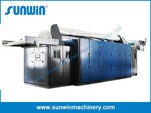
In textile processing, the final quality of the product is generally more stringent. After a lot of processing, it is likely that some minor problems such as deformation will occur. Under such circumstances, it is necessary to carry out the post-production of the textile, including tenter finishing and shaping, so that the tenter setting machine is needed at this time.
Combined with the work and application of the stenter equipment, the main purpose of the equipment is to improve the feel, slip, color, width, strength, appearance and the like of the fabric by tenter styling. Moreover, for some non-cotton textile fabrics, the processing of the equipment can also achieve the effect of stable size. During the operation of the equipment, the cloth is mainly immersed in the material tank in the material tank, and is evenly pressed by the rolls, and then enters the oven. When the cloth passes through the oven, it will be dried and shaped under the action of high temperature hot air, and the cloth after the setting has a good hand feeling and a stable size.
So, what is the basic composition of this tenter setting machine? In fact, the equipment mainly consists of five parts, namely the loading part, the weft feeder, the chain, the oven body and the falling cloth. There are also chemical systems and oil furnace heating systems. The structure design of the loading part is relatively simple, mainly consisting of a trough and a roll, the cloth enters the trough, is loaded with chemical materials, and then the excess chemical material is pressed and cleaned by a roll.
In this process, the staff needs to pay attention to the fact that the pressure on the left and right sides of the stenter equipment rolls should be consistent. Otherwise, the side with less pressure will have more material, while the one with higher pressure will have less material, and the cloth will have quality problems such as left and right inconsistency.
In the tenter setting machine, the weft feeder is also an important component. At present, four sets of sensors are often arranged on a weft-aligning device. Each set of sensors includes two parts, light-emitting and light-sensing, which can output the weft of the cloth by photoelectric effect, and the action part is driven by a hydraulic system.